Virtual Poker Table Physics Simulations and Their Unexpected Effects on Decision Timing in Online Tournaments
Developers have integrated detailed physics engines into online poker platforms to replicate the movement of chips and cards with greater accuracy, and these additions have begun to alter how players manage their decision windows in major tournaments. The simulations calculate trajectories for stacked chips that topple or slide across felt surfaces while cards flip and settle according to velocity parameters drawn from real-world observations. Observers note that these visual layers extend the interval between action prompts and final inputs because participants often pause to register the completed animations before committing to bets or folds.
Core Components of Modern Table Simulations
Physics models track multiple variables during each hand including chip mass, friction coefficients on virtual surfaces, and collision responses when stacks interact with the table rail. Card dealing sequences incorporate spin rates and air resistance factors that determine how long a card takes to reach its final position in front of each player avatar. Research from the University of Alberta's poker AI laboratory indicates that platforms using these layered calculations register average decision latencies 1.8 seconds longer than those relying on simpler sprite-based animations, with the difference most pronounced during heads-up confrontations where multiple chip movements occur in quick succession.
Software engineers adjust gravity and bounce values to prevent unnatural clipping effects, yet the resulting motion paths require players to track objects across the screen before the interface registers their next action as valid. Data collected from mid-2026 events shows that tournaments hosted on engines with high-fidelity physics recorded a 14 percent increase in time-bank activations compared with earlier software versions that used static card placements.
Timing Shifts Observed in 2026 Online MTTs
June 2026 brought several large-scale online series that adopted updated simulation packages, and aggregate logs from those events revealed consistent patterns in decision pacing. Players facing flop decisions waited an extra 0.9 seconds on average when chip-fling animations played out, while river calls extended further because participants tracked the final card's settling motion before selecting an option. Figures released by the Nevada Gaming Control Board document similar extensions across regulated interstate platforms, noting that the added visual processing correlates with fewer snap decisions and more frequent use of remaining clock seconds.
Platform operators have responded by introducing optional toggle settings that reduce animation duration without disabling the physics layer entirely, yet adoption rates remain below 30 percent among tournament regulars according to internal telemetry shared at industry gatherings. Those who keep full simulations active report that the realistic motion helps them maintain immersion across long sessions, while the same realism introduces micro-delays that accumulate over hundreds of hands.
Interaction Between Visual Cues and Cognitive Load
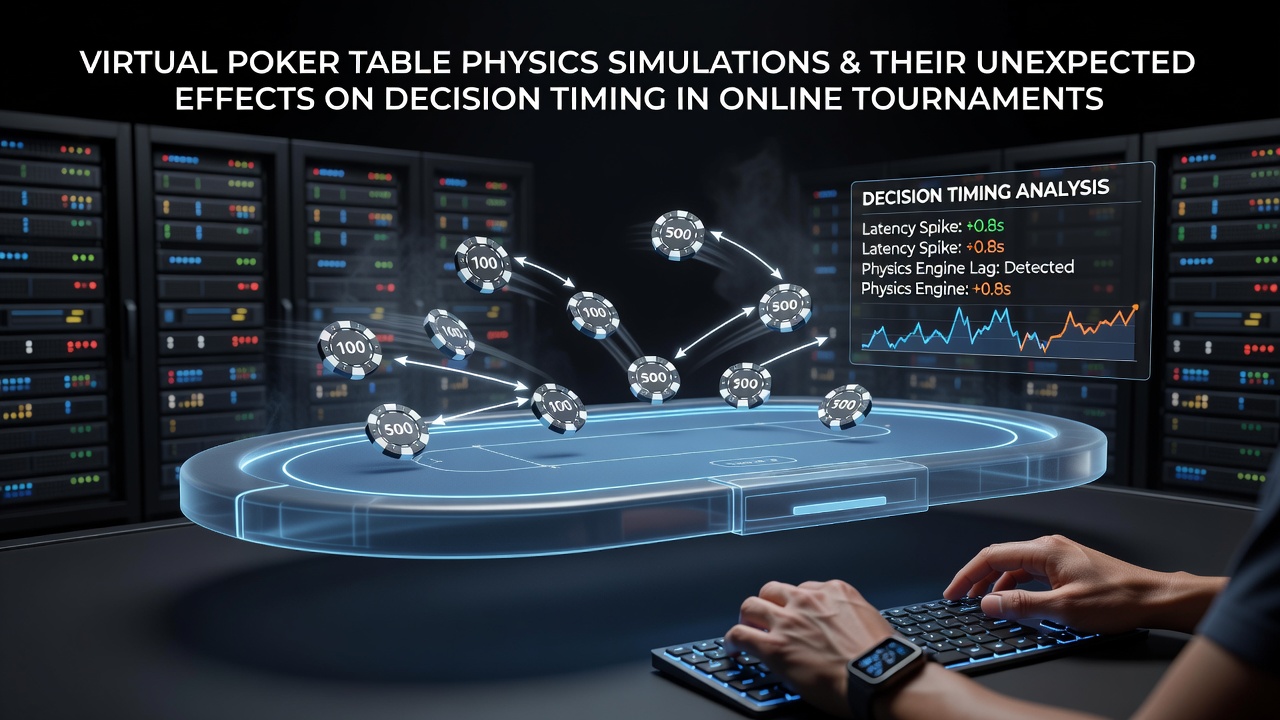
Eye-tracking studies conducted on volunteer participants demonstrate that attention remains fixed on moving chips or cards for the full duration of their travel, delaying the moment when the decision interface regains focus. This sustained visual engagement leaves less residual time for mental calculation of pot odds or range construction, particularly in multi-way pots where several stacks must settle before action proceeds. Reports compiled by the Australian Communications and Media Authority highlight that platforms incorporating variable physics parameters experience wider spreads in per-hand timing data, with outliers extending beyond standard 30-second limits more often than on simplified interfaces.
Programmers have begun testing predictive rendering techniques that preload subsequent animation frames based on probable action sequences, though these optimizations have not yet eliminated the measured timing gap. Tournament directors note that the change in rhythm has prompted some players to adjust their pre-action routines, such as pre-selecting fold or call buttons earlier in the animation cycle to compensate for the added visual processing interval.
Platform Adjustments and Player Adaptation Patterns
Leading operators now provide granular controls for animation intensity that allow users to shorten chip travel distances or accelerate card flips while preserving core physics integrity. Early results from these configurable environments indicate that decision timing distributions narrow when animation length drops below 1.2 seconds, bringing them closer to legacy platform benchmarks. Participants who experiment with reduced settings often revert to full simulations after several sessions because the abbreviated motion feels less natural during extended play periods.
Training modules released alongside the June 2026 software updates include drills that require users to practice decisions while tracking moving objects, aiming to build tolerance for the extra visual load without sacrificing accuracy. Aggregate performance metrics from these modules show modest improvement in response consistency after repeated exposure, although the gains plateau once baseline familiarity with the physics layer is achieved.
Conclusion
Virtual poker table physics simulations continue to evolve as platforms balance visual fidelity against the practical constraints of timed decision windows in online tournaments. Available data from regulatory reports and academic laboratories document measurable extensions in average response intervals that coincide with the adoption of these engines, prompting ongoing refinements in both animation parameters and player preparation methods. Future updates will likely focus on further synchronization between simulation length and clock mechanics to maintain competitive balance across varying connection speeds and device types.